

In the quiet coastal village of Doshani in Bagerhat, southwest Bangladesh, Purnima Biswas, a 40-year-old mother of two, once lived in a world shrouded by darkness—both literally and figuratively. Her story, woven with resilience and hope, exemplifies the transformative impact of the Vision Bangladesh Health and Education Society (VBHES) under Strategic Objective 5 (SO5): Facilitating Social Protection, Gender-Based Violence (GBV) Prevention, and Mental Health and Psychosocial Support (MHPSS) for Deprived and Underprivileged Communities. Purnima’s journey from isolation and despair to empowerment and advocacy reflects the program’s holistic approach to addressing systemic vulnerabilities through community-driven interventions.
Purnima’s life was marked by relentless hardship long before she lost her vision. Born into a family of subsistence farmers, she married at 16 to a day laborer, moving to a modest mud-brick home in Doshani. The couple struggled to provide for their two children—a son, now 18, and a daughter, 14—amid the region’s poverty, exacerbated by frequent cyclones and saline soil that limited agricultural yields. Purnima supplemented the family income by weaving baskets, but her world began to unravel in 2021 when cataracts clouded her vision. By 2022, she was nearly blind, unable to work or care for her family. “I felt like a burden,” she recalls. “I couldn’t see my children’s faces or cook for them. My husband worked longer hours, but we still went hungry.”
The loss of vision compounded Purnima’s vulnerabilities. She became increasingly isolated, confined to her home, and dependent on her daughter, who dropped out of school to assist her. This decision weighed heavily on Purnima, as she knew education was her daughter’s path to a better future. Socially, Purnima faced stigma; neighbors whispered that her blindness was a curse, deepening her sense of shame. The lack of accessible healthcare in Doshani where the nearest hospital was 12 kilometers away over treacherous roads—made treatment seem impossible. Financial strain and emotional distress took a toll, leading to anxiety and depression. “I stopped talking to people,” Purnima shares. “I thought my life was over, and I was dragging my family down with me.”
Purnima also faced subtle forms of gender-based violence. Her husband, under pressure to provide, grew frustrated, and arguments became frequent. While not physically abusive, the emotional strain eroded their relationship, leaving Purnima feeling powerless. In Doshani, like much of southwest Bangladesh, GBV, including domestic tension and early marriage, is prevalent, with many women lacking access to support due to stigma and isolation. Purnima’s story mirrored that of countless others in her community, where poverty, mental health challenges, and gender inequities create a cycle of vulnerability.
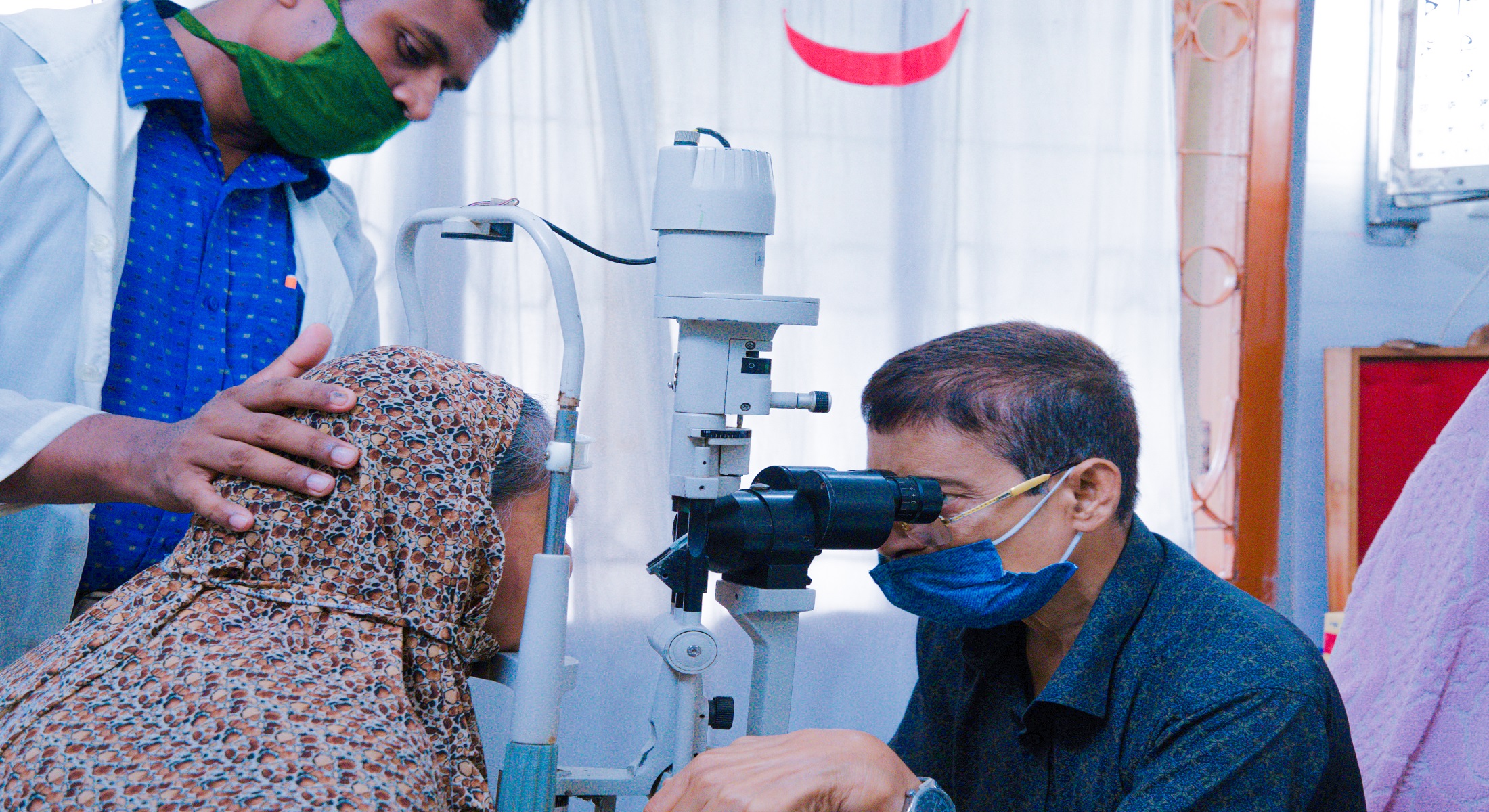
In early 2024, Purnima’s life changed when a community volunteer from VBHES’s SO5 program visited Doshani. The Social Protection, GBV, and MHPSS Program, designed to empower underserved communities, identified Purnima during a household survey targeting vulnerable women and children. Recognizing her dual challenges of blindness and emotional distress, the program connected her to the Bagerhat Eye Hospital, a VBHES initiative under Strategic Objective 3, which performed approximately 400 sight-restoring surgeries in FY 2024, including cataracts. Purnima received free cataract surgery in mid-2024, a transformative moment. “When the bandages came off, I could see my husband’s face clearly again,” she says, her voice trembling with emotion. “I saw my children smile, and it felt like I was reborn.” The surgery, supported by pre- and post-operative care, restored her vision fully, enabling her to resume daily tasks and regain independence. This intervention not only addressed her physical impairment but also sparked a renewed sense of purpose.
However, VBHES’s support extended far beyond the surgery. Recognizing Purnima’s emotional and social challenges, the program enrolled her in MHPSS services, a cornerstone of SO5 that has reached thousands of individuals. Community-based group therapy sessions, facilitated by trained counselors and volunteers, provided Purnima a safe space to share her struggles with other women. These sessions, held in a local community center, addressed her anxiety and depression, teaching her coping strategies like mindfulness and stress management “Talking with others who understood my pain helped me feel less alone,” Purnima explains. “I learned to let go of my fears and believe in myself again.” The majority of MHPSS participants, like Purnima, report improved emotional resilience, reflecting the program’s impact.